
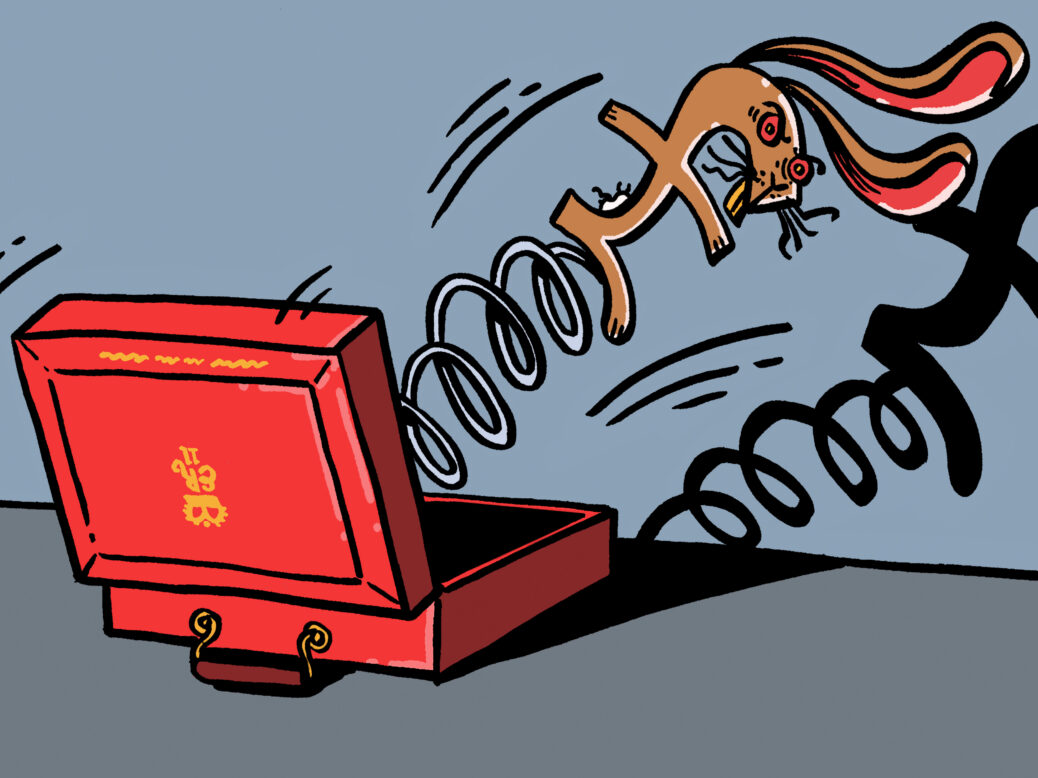
Drivers queue at petrol pumps. Lenders withdraw mortgage offers. Farmers make more money selling fertiliser than growing crops. Rural households and businesses pay double what they did a fortnight ago for heating oil. Flight prices spiral upwards. Britain is feeling the first sparks of a huge shock pulsing its way across the world. Because of its reliance on gas imports, the UK is forecast to be hit harder than almost any other major economy by the impact of the Iran war. Ministers crank up their best rictus grins and tell us not to panic. Energy bills are frozen until July, they reassure us, and there’s plenty of time before winter comes for the conflict to simmer down and the price of oil to even out. Take your time, nod the wise heads, see how this plays out.
Behind the scenes, though, there is an acceptance that there is no going back. Reliable private intelligence I’ve seen suggests that the resilience of the Islamic Revolutionary Guard Corps means the “conflict could drag on well beyond any formal end to the war” and its consequences – including “persistent disruption in the Strait of Hormuz” and “cyberattacks on Western infrastructure” – could be “broader than anticipated” for Western countries such as Britain.
The markets know this. And your average Brit knows it in their bones, too. Inflation expectations among the public have made the biggest jump on record, with people predicting a rise from 3.3 per cent to 5.4 per cent in a year. This becomes an economic force in itself: we cut back, we stockpile, we try to get a pay rise.
I found this when I visited “Tesco Town”, London’s biggest Tesco, shortly after the war broke out, and as petrol prices started to rise. During the so-called magic hour when staff start sticking yellow discount labels on to products, shoppers of all backgrounds – from white-collar remote workers to students, housing officers to nurses – were cutting back and struggling to budget. They told me they expected their bills to rise, and could trace how the tremors of bombs in the Middle East would eventually be felt in their supermarket trolleys. You’d think such inflation literacy might be a help to ministers who apparently cannot explicitly blame rising costs on Donald Trump. But what was clear in these conversations – and I’ve heard the same in the years since Covid-19 – was an expectation the state would step in.

Universalism (services and benefits for the whole population, rather than means-tested assistance) has dwindled since the New Labour days. But the approach was reincarnated in the form of furlough and other pandemic schemes, and in Liz Truss’s ill-fated energy price guarantee for all households. We now know that, in extremis, the government can shelter us all from the hardest rain.
Until it can’t. With a 93 per cent debt-to-GDP ratio, and the “moron premium” still charged on gilts following the mini-Budget fiasco, Labour is only pursuing targeted and limited help. The Chancellor, Rachel Reeves, speaks of “support for those who need it most”, based on household income. The end of universalism means safety nets for some and sheer drops for others. The already “squeezed middle” also suffer the further frustration of being on the wrong side of tax and benefits cliff-edges.
For more than two decades, the average family in Britain has been getting poorer. The median family income is £31,000: it would be £51,000 now if we’d remained on the same growth trajectory as we were on in 2005. Typical incomes for working-age families grew just 7 per cent over the 20 years between 2005 and 2025 (the decade before, 1995-2005, they grew by 35 per cent), according to the Resolution Foundation, a living-standards think tank.
Couple this with workers being dragged into higher tax brackets by frozen thresholds, and you end up with a very different sense of what it means to be rich or poor today than two decades ago. This is a Britain in which nurses rely on foodbanks, doctors keep striking to catch up with their predecessors’ pay and a third of teachers are charged as higher-rate taxpayers. Despite the mass higher education and decline of manual jobs over recent decades, more Brits call themselves “working class” than they did 40 years ago, the British Social Attitudes Survey reveals.
Even those in the top 5 per cent of earners (£90,500 and over) are much closer to the national median personal income of £36,663 than to the top 1 per cent (£201,000 and above), where wealth is rapidly accumulating. In his book The Inequality of Wealth, the Labour MP Liam Byrne details how the average wealth of an individual in the top 1 per cent of Britain’s richest increased 31 times more than that of those in the bottom 99 per cent between 2010 and 2021.
Over the past few years, I’ve travelled through affluent market towns and comfortable commuterville, and sat in on focus groups in the marginal seats of Middle England. The same story echoes throughout: life’s pleasures are drifting ever out of reach. We haven’t had a “proper holiday” in years; it’s too expensive to eat out; the kids will have to make do with less this Christmas. No one uses the term “social contract”, but it’s clear that the good life for those who work hard is no longer a guarantee. Keir Starmer once spoke of “ordinary hope”; voters are running out of it, and expect something more concrete amid the turmoil to come.
[Further reading: Has Reform UK discovered human rights?]
Content from our partners
Related
This article appears in the 08 Apr 2026 issue of the New Statesman, The Fall
Join the debate
Subscribe here to commentHow can the state take care of us, if it has so little money to meet increasing need? The state and the squeezed majority need to look to the top 1-percent, ‘where wealth is rapidly accumulating’.